
Keep the supply line clean. Protect the wrist motion.
Spraying routes carry paint, coating or cleaning lines to a tool that rotates continuously. The hose path has to preserve supply, avoid kinks and keep cleaning and service access practical.
Start with what the route has to survive.
The process creates the environment; the robot and tool create the geometry. A useful dresspack review connects them before a series or diameter is fixed.
The paint or coating hose has a minimum bend radius.
A compact route can kink the hose and make the supply or cleaning cycle unstable.
Overspray reaches the wrist and cable route.
A rough outer surface can collect material and become difficult to clean.
The spray gun rotates through a repeated wrist cycle.
The hose can twist around the tool axis or pull at the connector.
The route is exposed to solvent or cleaning media.
Material compatibility and drain paths need to be checked before the first production run.
What to start with — and what to challenge.
Start here
- Start with the fluid hose's bend radius, weight and connector requirements.
- Keep the hose supported and separated from sharp edges and hot surfaces.
- Define a cleanable outer surface and avoid unnecessary low points.
- Check the route through the full wrist rotation and the gun-cleaning position.
Challenge before release
- Use a cable tie to force the hose into a tight radius.
- Assume the outer sleeve is compatible with every cleaning agent.
- Route the hose where overspray can collect in a connector recess.
- Copy a gluing route without checking the spray gun's rotation and cleaning cycle.
The route may need more than one system.
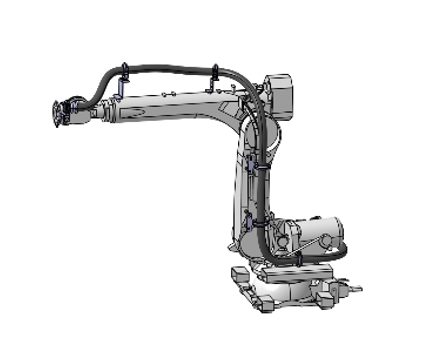
Series 2
Rotary bracket
Controlled wrist rotation for a supply hose and cable bundle.
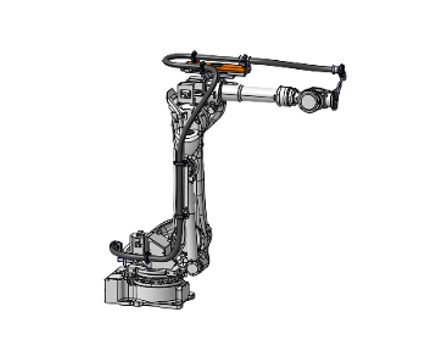
Series 5
Telescopic bracket
Compact storage where the spray cell is tight.
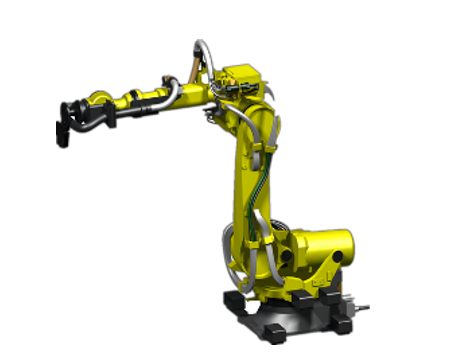
Series 6
C-flange
Body-following route with a defined service opening.
What we need to answer usefully.
- Robot brand, exact model, payload and wrist envelope
- Spray gun, nozzle, cap and cleaning position
- Paint/coating hose, air line and signal cable sizes, weights and bend limits
- Supply pressure, cleaning agent, temperature and allowed materials
- Overspray direction, drain points and cleaning method
- Connector access and the frequency of gun/nozzle changes
Before the kick-off call.
Can the paint hose share the robot's cable bundle?
It can share an outer route only if the hose's bend, weight, chemical exposure and cleaning requirements are met. It should remain separately supported.
Why does the hose kink at the wrist?
A fixed loop can be pulled tight as the wrist rotates. The route needs controlled slack and a support point that follows the motion.
Does a smooth cover solve overspray?
It helps only if the shape, joints and cleaning method prevent material from collecting. Compatibility with the cleaning agent still has to be checked.
Start with the robot and the thing that goes wrong.
We will turn the brief into a reference architecture, a list of unknowns and a drawing path.